Thursday, 23 January 2014

The Targets of the War on Heresy, part 2


HISTORIANS ON THE DECISION TO ATTACK THE TRENCAVEL LANDS


By the time twenty years of war over the Languedoc drew to a close with the Treaty of Paris in 1229, much had happened, but the immediate effect on the Occitan nobility was not as great as might be expected.  The Counts of Toulouse, though defeated by the French crown, were still lords of their domains.  The Counts of Foix still ruled theirs.  It is only the Trencavels who lost utterly, and their loss was both the first and last effect of two decades of holy war throughout the region.  Their lands had been the first to be attacked in the campaign of 1209; their Viscount imprisoned until his untimely death; their capital at Carcassonne seized and used as the crusaders' headquarters.  Their last heir, Raymond II, had fought against the crusaders alongside his neighbours the Counts of Toulouse and Foix, but at the Treaty of Paris, he was formally dispossessed of all of his lands and sent into exile while they were not. In this light, the Albigensian Crusade could appear to be a war against the Trencavels rather than against heresy or against Count Raymond of Toulouse. 

The previous post examined the question of why the crusade initially attacked the Trencavel lands as presented in the primary sources: the Pope's letter and the tales of William of Tudela and Pierre des Vaux-de-Cernay.  This post will present subsequent historians' different answers to this question.  It would not be fair to go further without pointing out the debt this analysis owes to Elaine Graham-Leigh, whose book "The Southern French Nobility and the Albigensian Crusade" is devoted to this subject.

The following points, established from the primary sources in the previous post, should be kept in mind:

1.  Both Raymond of Toulouse and Raymond-Roger Trencavel attempted to submit to the Church in order to avoid invasion by the crusaders.  Raymond of Toulouse's submission was accepted while Raymond-Roger Trencavel's was refused.

2.  Raymond of Toulouse's submission and the resultant safeguarding of his lands was anticipated by Pope Innocent III when he called the crusade, and Raymond's delegations had been received in Rome well in advance of the crusade's muster.  His reconciliation was therefore, presumably, anticipated by the papal legates leading the crusade.

3.  The authors of the primary sources do not discuss any decision-making process on the part of the crusaders.  Both William of Tudela and Pierre des Vaux-de-Cernay note that the crusade marched towards Beziers without explaining why.


THE HISTORIANS


Zoe Oldenbourg in "Massacre at Montsegur" (1959):
"Though Raymond VI was no longer an Enemy of the Faith, the Crusaders had not gone to all this trouble for nothing.  The Legates had already marked down their first victim for destruction, the first of many 'abettors and instigators of heresy' in Languedoc.  The property of the Viscount of Beziers had long been regarded as 'heretic's land' par excellence, and the young Viscount possessed neither the boldness nor the duplicity which characterized his uncle and liege lord, the Count of Toulouse."  (p. 110)
Oldenbourg here differs from many later historians in claiming that the leaders of the crusade planned, in advance, to target the young Viscount as "their first victim."  While this does seem likely, it is not at all clear that Oldenbourg's contention that the Viscount's property had "long been regarded as 'heretic's land'" is supported.  Three generations earlier, in 1145, Bernard of Clairvaux had preached against alleged heretics in the Languedoc, but his tour of the area did not specifically focus on the Trencavel lands, and the more recent legatine preaching campaigns had not focused on them either.

Jacques Maudale in "The Albigensian Crusade" (1967):
"It was [Arnaud-Amalric] who was responsible for the appalling massacre of Beziers and the burnings at Minerve and Lavaur.  It was he who refused to listen to the luckless Raymond-Roger Trencavel, the first victim of a Crusade directed not primarily against him but against Raymond VI of Toulouse." (p. 64)
Maudale does not venture an opinion on why Raymond-Roger Trencavel was "the first victim" of the crusade, but does attribute the decision solely to the papal legate, Arnau Amalric, who led the army at that time.

Jonathan Sumption in "The Albigensian Crusade" (1978):
"Then, on 22nd June, Raymond [of Toulouse] took the cross himself, promising on the Gospels to help and advise the army of God and to do all that its commanders asked of him.  This last act was possibly Raymond's shrewdest political stroke ....  Raymond knew that it was too late to halt the crusade ....  But by taking the cross he would earn the immunity of a crusader; his titles and dominions would be protected except perhaps for those that were in the hands of the Cathars.  He would become a leader of the crusade which would thereby be transformed into a war against Raymond's greatest enemy, Raymond-Roger Trencavel, viscount of Beziers.  When the crusaders had destroyed the Trencavels, their resources and perhaps their enthusiasm would be exhausted and Raymond would be left in effective control of his principality for the first time since his accession."  (p. 84)
Sumption is the first of the historians in my collection to blame Raymond of Toulouse for the initial direction of the crusade.  After this assessment, many other historians followed suit, forming a collective portrayal of Raymond as a malignant and clever opportunist who manipulated the confused and directionless crusaders into attacking the Trencavels in order to further his own political aims.  Sumption goes further than anyone else by suggesting that Raymond, despite his vilification by the Pope, became "a leader of the crusade" capable of transforming not only its direction but its purpose.

 Malcolm Lambert in "The Cathars" (1998):
"Raymond [of Toulouse] warded off imminent threat by professing repentance, accepting terms and submitting to a humiliating penance ....  He joined the army as crusader for the minimum forty days, perhaps in his cunning way hoping to gain by an attack on his rival, the 24-year-old Raymond-Roger, viscount of Beziers, who had declined to join with Raymond in submission." (p. 102)
Lambert follows Sumption in assessing the targeting of the young Viscount as due to Raymond of Toulouse's "cunning".  He differs from Sumption in portraying Raymond as a somewhat reluctant crusader -- "for the minimum forty days" -- rather than as one of its leaders.  Lambert's assessment that Raymond-Roger Trencavel "had declined to join with Raymond in submission" doubtless comes from William of Tudela's report cited in the previous post.  However, William clearly portrayed Raymond's discussions with his nephew as a request for a cease-fire and defensive alliance: "[Raymond] begged him not to attack him; let them stand together in defence."  There is no indication that Raymond of Toulouse ever requested his nephew to submit to the Church.  Nonetheless, the young Viscount did attempt to submit and was refused -- a vital fact ignored by Lambert.

Malcolm Barber in "The Cathars" (2000):
"However, Raymond VI, after a fruitless attempt to persuade Raymond Roger Trencavel to make common cause with him, decided to cut his losses by undergoing a penitential scourging and then, in June, joining the crusaders.  ...  Nevertheless, this did mean that the main force of the crusade was initially directed against the two chief Trencavel cities of Beziers and Carcassonne, despite William of Tudela's view that Raymond Roger was 'certainly Catholic', and despite the fact that, until this time, the pope had been almost exclusively concerned with placing the blame on the shoulders of Raymond of Toulouse.  By turning to the weapon of the crusade, the Catholic authorities had in practice abandoned the attempt to unpick the strands of Languedocian society and thus isolate the heretics." (pp. 120-121)
In this summation, Barber reports the facts much as they appear in the primary sources.  His conclusion in the last sentence, however, suggests that "the Catholic authorities" in attacking the Trencavel lands were no longer trying "to unpick the strands of Languedocian society".  This would be true if the Trencavel were not already isolated and if an attack on them might serve to unite the other nobles of Languedoc against the crusade.  A few years later, however, Elaine Graham-Leigh would present a powerful argument that the choice of the Trencavels was an astute one, demonstrating a nuanced understanding of those very strands of Languedocian society.

Elaine Graham-Leigh in "The Southern French Nobility and the Albigensian Crusade" (2005):

"Based on military considerations, the decision to aim the first crusade campaign against Beziers and Carcassonne appears to support the view of the crusade as unrelated to the politics of Languedoc, selecting targets according not to who owned them but to their strategic importance.  However, it is by no means certain that such straightforward military reasoning was paramount in the choice of the targets of the crusade.  It can be argued on the contrary that Raimond Roger's lands were attacked by the crusade because they were held by Raimond Roger and that in making such an attack the crusaders were engaging with the political and social realities of early thirteenth-century Languedoc." (p. 46)

"That the crusaders' campaign against Beziers and Carcassonne was specifically directed at Raimond Roger himself, and not simply at two desirable towns affected by heresy, is indicated by the crusaders' attitudes to Narbonne.  Narbonne was a large and important town, the seat of the Metropolitan and a wealthy commercial centre, situated east of Carcassonne and south-west of Beziers.  ...  The crusaders appear to have received the submission of Narbonne in 1209 ....  The crusaders, however, do not seem to have bothered to take control of the town themselves.  Following his surrender, Viscount Aimery [of Narbonne] gave some rather unenthusiastic support to the crusaders, but they themselves do not appear to have maintained any presence in the town. ... In their acceptance of Aimery's surrender and their subsequent departure from Narbonne, the crusaders demonstrated a different attitude towards the town than towards Beziers and Carcassonne, one which cannot be readily accounted for.  If it is assumed that the crusaders were embarking on a war of conquest in Languedoc, Narbonne should have been rich and important enough to attract their attention, while, if they are credited with more religious motives, there is no evidence to suggest that Narbonne was notably free from heresy in comparison with its neighbours." (pp. 51-53)

"Raimond Roger's attempted surrender to the legate indicates that the difference in the treatment received by Narbonne from that meted out to Beziers and Carcassonne by the crusaders cannot be explained simply in terms of the apparent difference in responses which the crusaders encountered from these towns.  It suggests that the significant difference between Narbonne, Beziers and Carcassonne was that the latter were towns belonging to Raimon Roger and the former was not." (pp. 54-55)

Graham-Leigh goes on to build a convincing case that it was ecclesiastical policy, set by Innocent III and carried out by Arnaud Amalric and then by Simon de Montfort which dictated the conquest of the Trencavel lands.  She explains that the Trencavels lacked serious military allies in their neighbours, especially the Counts of Toulouse and Foix, who in the event made peace with the crusade in the first campaign season even while Beziers was burned and Carcassonne taken.  Even within what might be considered the domain of Raimond Roger Trencavel, lesser lords such as Pierre Roger de Cabaret and Bernard de Saissac, were more concerned with defending their own castles than hastening to the young Viscount's side when he faced the crusading army.  In this light, the special treatment singled out for the Trencavels seems to have been quite astute -- the first target of the crusade was one which would not unite the Languedoc in opposition. 

Claire Taylor in "Heresy in Medieval France, 1000-1249" (2005):

"It [the Crusade] mustered in Lyon in June 1209 and approached the Languedoc via the Rhone valley, anticipating the confiscation of such lands as it could wrestle from the protectors of heretics.  The excommunicate Raymond VI sought reconciliation with the Church as it approached, not only because of this army but because his lands in the Agenais had been attacked by an earlier expedition.  ...  This they [his clerical friends] did successfully in Rome, so that when the main crusade arrived Raymond had already, on 18-22 June, taken the cross and could not be attacked.  The lands of Viscount Raymond-Roger Trencavel in the eastern Languedoc were targeted instead."  (p. 188)

In describing the crusaders' anticipation, Taylor suggests that they had no particular plan other than to attack any lands held by "protectors of heretics" but without specifying how they would determine that any given land-holder was one. 


Christopher Tyerman in "God's War" (2006):
"The main expedition mustered at Lyons on 24 June 1209 and set out down the Rhone at the beginning of July.  By this time the whole strategic context of the expedition had been thrown into confusion from which it never properly emerged.  The expected target, Raymond of Toulouse, suddenly became an ally, no doubt to the relief of those of his vassals and close relatives who were marching with the crusaders.

...

Cheated of their expected victim, the crusaders turned their attention to the Trencavel lands, incontestably riddled with heretics, even though the young and engaging viscount himself was recognized as orthodox.  This made little difference.  The crusade needed an enemy; Raymond of Toulouse short-sightedly promoted an opportunity to destroy a troublesome vassal while escaping attack himself." (pp. 589-590)
Tyerman here follows previous historians in blaming Raymond of Toulouse for selecting his nephew as a target.  He differs from them, however, in considering the choice to be "short-sighted" rather than "cunning" or "shrewd".  Even if Raymond could have directed the course of a crusade which initially set out to fight him, however, Tyerman does not offer any suggestion of what a more "far-sighted" course would have been.

Mark Gregory Pegg in "A Most Holy War" (2008):
"The enmity [of the other crusaders] toward Raimon was understandable -- he certainly understood it -- as all those who had signed themselves with the cross had done so weeks and months earlier with the fierce intention of assailing him and expunging heretics from his territories.  Yet -- remarkably, importantly -- even though the count was apparently no longer the enemy of Christ, the thrill and purpose of the crusade was no less dampened and no less focused.  Raimon as a crusader did not change the fact that the serpents and little foxes were invading Christendom from his cities and castra.  A landscape of pestilence still existed between the Garonne and the Rhone that needed to be cleansed through holy war and, while the peccant roots of heresy were momentarily beyond His sword, the shoots and branches of the plague could be sheared and hacked.  Arnau Amalric, with this in mind, surveyed the horizon and, gauging what lay between him and His eventual victory over the Provinciales heretici, decided to attack the lands of the twenty-four-year-old Raimon Roger Trencavel, viscount of Beziers, Carcassonne, Razes, and Albi ...." (p. 69)

"[Milo the papal legate] always intended to attack Raimon Roger sooner or later, as he (and so Arnau Amalric) despised the nephew almost as vehemently as they did the uncle.  Guilhem de Tudela's excursus into why the Trencavel territories were targeted by the crusaders, a contrary tale that blamed (and praised) everyone, was no more than songful supposition about a fateful decision he did not understand.  The troubadour was not alone in his ignorance.  There can be no doubt -- despite arguments to the contrary, then and now -- that Raimon was startled by the selection of his nephew as the new objective of the holy expedition.  The count, of course, wanted to deflect the crusade away from himself, but, as to where or to whom, that is far from clear; he never suggested Raimon Roger." (p. 70)
Pegg asserts, as Graham-Leigh had suggested, that it was the intention of the legates (Milo and Arnau Amalric) to attack Raimon Roger Trencavel and he firmly rejects the idea that Raymond of Toulouse could have or would have made the decision.  In stating that the Count of Toulouse was "startled" by the decision, however, the same problem arises as in Tyerman's statement of the opposite: if the target had not been Raimon Roger Trencavel, then whom else?  Surely no one considered that the crusaders would go turn around and go home with their pledge to wage holy war unfulfilled.


Laurence Marvin in "The Occitan War" (2008):
"By 24 June the bulk of the crusader army had formed in the city of Lyon.  Up until that point the leaders intended to invade the heretically infected western lands of the Count of Toulouse, since he was the main noble villain identified by the church as harboring heretics.  That changed when the count became a crucesignatus himself on 22 June.  He immediately made use of his new status and met the crusader army as it left the city of Valence, ninety-one kilometers south of Lyon along the Rhone valley.  At a meeting with the crusade leadership, Raimon VI managed to convince them of his sincerity ....  Since the leaders and rank and file of the army were still determined to punish someone for heresy, Raimon convinced the crusade leadership to invade his nephew's lands in the viscounty of Beziers, Carcassonne and Albi.  Though Raimon VI was Raimon-Roger Trencavel's maternal uncle, the Raimondine and Trencavel houses had been at odds for most of the past century.  Convincing the crusade to attack his nephew must have relieved and delighted Raimon VI, since he had deflected a huge army bent on destruction from his own lands to those of one of his greatest rivals." (pp. 37-38)

As another historian following the tradition of blaming the Count of Toulouse for the decision, Marvin emphasizes the suddenness of the decision, as if to suggest that a great confusion came over the crusaders on 22 June when Raymond joined them and that it was this sudden confusion which allowed them to be convinced to begin their campaign at Beziers.  This ignores, however, the months of diplomatic efforts which preceded Raymond's formal ritual of reconciliation.  Raymond had discussed his submission with Arnau Amalric much earlier.  He had sent delegations to Rome to obtain the Pope's approval.  The formalities of 22 June had been previously arranged by Milo, the papal legate.  It is simply not possible that this took anyone by surprise.

R. I. Moore in "The War on Heresy" (2012):
"Without hope of repelling such a force, the only move left to Raymond was to join it, earn the crusader's immunity for his own lands and turn the storm against the vicomte of Beziers.  Raymond-Roger, grasping at last the depth of his danger, met the army at Montpellier with protestations of innocence and regret and offered to submit on the same terms as Raymond of Toulouse had done.  Arnold Amalric declined to hear him and proceeded to Beziers, which on 21 July was sacked, plundered and destroyed by fire.
...
Raymond-Roger himself was seized and chained, despite the safe conduct he had been promised, and died in prison three months later, to be remembered as youthful -- twenty-four years old when he died -- handsome, gallant and foolish, or betrayed.  All that he may have been, but he was also the unfortunate legatee of the long and bitter rivalry between the counts of Toulouse and of Barcelona, now kings of Aragon, in which the Trencavel lands were strategically pivotal.  There is no real reason to think that the region was especially given to heresy, but it had repeatedly been portrayed as such by those who hoped to dominate it, at least since Count Alphonse Jordan of Toulouse pointed St Bernard in that direction in 1145." (pp. 247-249)
Here, R. I. Moore discounts the theory that the Trencavel lands were attacked because they were more rife with heresy than their neighbours and points out the different treatment of the attempted submissions of Raimon Roger Trencavel and Raymond of Toulouse.  He does, however, also follow the tradition of crediting the Count of Toulouse with "turning the storm" against the Trencavels for political reasons.

SUMMARY


There is no consensus among historians about how the Trencavels came to be attacked first in the campaign of 1209.  It has been suggested, and refuted, that their people were notably heretical.  This theory dovetails nicely with the idea of the Albigensian Crusade as a "war on heresy", but there is little or no evidence to support it.  It has more frequently been suggested that Raymond of Toulouse, either deftly or foolishly, manipulated the crusaders into attacking his nephew Raimon Roger Trencavel.  As the Count of Toulouse was the originally declared target of the crusade, this requires one to believe that the crusaders gave over the leadership of their war to their intended enemy -- a problem which can be mitigated by exaggerating the suddenness or unexpectedness of Raymond's reconciliation with the Church.  Lastly, historians differ on whether the choice of the Trencavel lands was short-sighted and blunt or whether it reflected a more nuanced understanding of the Trencavels' vulnerable position in the society of Languedoc.

The question of how the Trencavel lands came to be initially targeted instead of other cities in the Languedoc, is similar to the question of why the Trencavels were permanently dispossessed while other comital families remained in control of their lands despite having fought the crusaders and lost.  In their answers to these two questions, historians go a long way towards describing the nature and result of the entire Albigensian Crusade.  Considering the paucity of evidence in the primary sources, it seems more likely that it is their attitudes towards the Albigensian Crusade itself which inform their arguments about the treatment of the Trencavels.  Those who see the Crusade as a holy war against religious dissent suggest that the Trencavel lands were especially heretical; those who see it as a primarily expedient military exercise  stress the strategic significance of the territories; those who see it as a personal struggle over the allegiance or faith of individual rulers emphasize Raymond of Toulouse's role.  In the absence of agreement on this crucial issue, future historians remain at liberty to tell the story in the way which best suits their overall perspective.

After the initial conquest of the Trencavels, Simon de Montfort was made leader of the crusade.  It is often said that, under his leadership, the course of the Albigensian Crusade diverted from its original goals to serve his personal hunger for power.  In the next post, I'll explore the evidence for and against this proposition and speculate on whether Simon was a power-mad, bloodthirsty warlord (as he is sometimes portrayed) or whether he ended up as a scapegoat for policies and strategies which he had no hand in forming.

Thursday, 26 December 2013

The Targets of the War on Heresy, part 1

The Albigensian Crusade has often been portrayed as a "War on Heresy," but this is at best a slogan rather than a suitable description of events.  In phrasing, it is reminiscent of the modern "War on Terror" and shares certain features with it.  Both have been subject to criticism due to the gap between the vague ideological objective of combating a concept and the practical necessity of identifying specific targets for military action.  In practice, the Albigensian crusade seems to have done a poor job of seeking out or countering unorthodox religious beliefs.  If that sort of nicety ever crossed the minds of the crusading leadership, it was not recorded in the primary sources.

Wars and invasion forces must have specific targets -- they must march on particular locations and engage with particular forces deemed to be enemies.  The selection of those targets during the Albigensian crusade was problematic for the Catholic Church and continues to cause disagreement among modern historians.  There were certainly differences between the targets described in the initial preaching of the crusade, the targets which the crusade first attacked, and the targets on which it eventually turned.  The question of how these targets were chosen and how those choices came to change is one that continues to cause difficulty to this day and is the subject of this post.

THE INITIALLY INTENDED TARGET OF THE ALBIGENSIAN CRUSADE


It is clear from the very earliest contemporary sources that great ambiguity existed about the actual targets of the crusade.  In the letter of Innocent III calling for this crusade, the pope repeatedly emphasized that this holy war would be an act of vengeance for the murder of Peter of Castelnau.  Although he clearly blamed Count Raymond of Toulouse for the murder and levied many legal and religious punishments against him, the pope separated these sanctions, which were to be enacted by his bishops and legates, from the actions to be performed by the lay crusaders.

"Let us turn now," he wrote "to those who, fired with zeal for the true faith, are ready to gird themselves to avenge this righteous blood ... and to resist those villains who are attacking peace and truth."  Who "those villains" were, however, was left unstated.  Innocent continued to characterize the targets of his crusade without naming them: "Let us emphasise that those villains are striving not merely to snatch our possessions but to take our lives; they are not merely sharpening their tongues to attack our souls, they are raising their hands to attack our bodies; they have become corrupters of souls and despoilers of lives."  The only life taken at this time seems to have been that of Peter of Castelnau, but Innocent's rhetoric here broadened the scope of the war to include those who might later be found "raising their hands to attack our bodies."  In other words, the targets of the crusade were already being identified as those who would come to resist it.

This broadening of scope was reinforced immediately afterward when Innocent discussed the desirable possibility that Count Raymond would submit and be reconciled with the Church.  After this, he again hinted only vaguely about those who might be targeted by the crusade after such a reconciliation.  He left that decision to his legates.  "Accordingly we enjoin and instruct the archbishops and bishops (reinforcing our prayers with commands and our commands with prayers) to give most careful heed to the advice and directions of the legates and help them like true comrades in arms to carry out whatever instructions they issue for the success of our enterprise.  Let them understand that we have laid it down that any sentence pronounced by the legates against those who stand against us or those who stand idly by are to be held valid and strictly observed."  In lieu of Count Raymond himself, anyone the legates chose who opposed the crusade or even attempted neutrality were decreed as valid targets.  "Work to root out perfidious heresy in whatever way God reveals to you," he enjoined in his conclusion.

It seems strange to begin a war, especially a crusade which called on lords and fighting men throughout Christendom, without a clear target.  Count Raymond had, of course, been clearly identified and targeted but his submission and reconciliation were almost expected and indeed occurred well before the war began.  Since this reconciliation had been anticipated, and since it required the agreement of the pope and his legates to occur, they must have planned for a crusade which executed its vengeance upon some other target. 

THE FOURTH CRUSADE AS AN EXAMPLE OF MISDIRECTION


Could tens of thousands of holy warriors have embarked on crusade without any real idea of whom they might be fighting?  It seems absurd, but that claim is frequently made about Innocent's launch of the Fourth Crusade, just a few years earlier.  The preaching of that crusade and the papal propaganda produced for it all exclusively cited Jerusalem as the destination of the crusaders.  The crusading kingdoms of the Holy Land, however, had achieved a truce with the Saracens which seemed to preclude a Christian attack on Jerusalem.  As Christopher Tyerman put it in "God's War" (p. 509): "Given the Palestine truce of 1198, an expeditionary force to the Holy Land would not have been welcome.  This seemed to be of some importance to the crusade high command.  In their 1201 treaty with the Venetians to mount an attack on Egypt, they explicitly agreed the fleet would sail direct to Egypt, implying an avoidance of a landfall in mainland Outremer, which would compromise King Aimery's diplomacy.  This insistence on deferring to the 1198 truce may partly explain the leadership's consistent and strident hostility to any who wished to leave the army to sail straight to Palestine."

This divergence between the Church's publicly stated goals and its actual intent was dramatically demonstrated in the creation of the treaty with Venice to transport and support the crusade.  As Tyerman relates (God's War, pp. 512-3): "A secret understanding that the destination of the armada would be Egypt, specifically Cairo, 'because from there the Turks could be more easily crushed than from any other part of their territory', was omitted from the text of the treaty for public relations reasons.  However, the nature of the fleet, including the specialist uissier landing craft and the large squadron of Venetian galleys, clearly indicated an attack on hostile beaches and fighting at sea or in rivers, the Nile Delta, not the friendly port of Acre or the hills of Judea."

Infamously, the Fourth Crusade sailed for neither Jerusalem nor Cairo, instead sacking first Zara and then Constantinople, before annexing most of the Byzantine Empire and extending the Catholic Church's rule over what had previously been the Eastern Orthodox Church.  Innocent's role in the final outcome remains disputed and his actions at the time were contradictory.  He initially forbade any attack on Christians but qualified that by adding "unless necessary".  He excommunicated the crusaders after the fall of Constantinople, but accepted his tribute of booty from the despoiled city and reconciled the crusaders afterwards.  He claimed to be appalled by the forcible conversion of the East to Catholicism, but gladly accepted his increased dominion.  The details of the decision-making are obscured by stories of undelivered messages, disobedient legates and divided councils.  Although most historians, including Tyerman, agree that the results of the Fourth Crusade were not intended by the Pope, his legates, or the crusade's commanders, it does seem clear that a massive crusading undertaking could be launched without clear agreement on its target and, in fact, with considerable duplicity about it.

THE PRIMARY SOURCES ON THE TARGET OF THE ALBIGENSIAN CRUSADE


After the reconciliation of Count Raymond of Toulouse, the Albigensian crusade marched first on Beziers and then on Carcassonne, the principal holdings of the young Viscount Raymond-Roger Trencavel.  Historians do not agree on how or why this occurred.  As always, we should begin our examination with the statements of the contemporary primary sources.

In the Historia Albigensis, Peter des Vaux-de-Cernay was curiously tight-lipped about the decision.  He devotes the end of section IV of the Historia to describing the reconciliation of Count Raymond.  In V, §§ 82-3, pp. 48-9 he described Count Raymond joining the crusade and renewing his pledges almost as if it were a last-minute surprise, but glossed over the decision to change the target of the crusade, if indeed such a decision occurred:


"In the year 1209 ... all the crusaders who had been making their way from various parts of France converged on Lyon, the ancient capital city of Gaul, in accordance with a common prearranged plan.

...

When Raymond, Count of Toulouse, heard of the arrival of the host of crusaders he became afraid that they would invade his territory, since his conscience was troubled by the recollection of the villainies he had perpetrated.  He therefore went out to meet them, almost as far as the city of Valence, but they had gone out with a high hand.  Accordingly, he joined them near the city, pretended that he wanted peace and gave a false pledge of compliance and a firm promise to subject himself to the orders of the Holy Roman Church and even to the will of the crusaders.  As his security for keeping to these undertakings he handed over certain fortresses to the barons and even indicated his willingness to offer his son or himself as hostage.  What more?  The enemy of Christ allied himself to the soldiers of Christ; they joined together and proceeded directly to Beziers."

Both Peter des Vaux-de-Cernay and William of Tudela depicted Raymond's prior reconciliation in similar terms.  Raymond had first approached a clerical meeting at Aubenas where he attempted to submit to Arnau-Amalric, the head of the Cistercian order.  Arnau-Amalric, however, stated that he could not accept such a decision himself, and instructed Raymond to make his appeal directly to Rome.  Raymond then sent envoys to Rome, including the archbishop of Auch, the abbot of Condom, the former bishop of Toulouse, and the prior of the Hospitallers at Toulouse.  As a result, a papal legate named Milo was sent to reconcile the Count and did so after ritually humiliating Raymond at a ceremony in St Gilles.

William of Tudela's account of these diplomatic efforts is mixed in with Count Raymond's efforts to reach some agreement with his nephew, the young Viscount Trencavel in Laisses 9, 10 and 11 of the Canso.  The editing of the Canso at this point is very uncertain.  The end of Laisse 8 has the crusading army already gathered "on the plains outside Beziers."  The two narratives of Count Raymond`s negotiations -- with Rome and with his nephew -- are then awkwardly entwined in the next three Laisses, but are abruptly interrupted (in the second half of Laisse 9) by a second prologue in which William reintroduces himself and his commencement of the song in the summer of 1210. 

This confusion of editing makes the chronology of events rather unclear.  It is certain that the crusaders were not camped just outside of Beziers prior to any of Count Raymond`s negotiations, although this is how it appears in the assembled text.  A certain sense of the order of events can be found in William`s description of the actions and apprehensions of the young Raymond-Roger Trencavel, however.  Raymond-Roger is first mentioned in the Canso in Laisse 9 (p. 15):

"I do not suppose the count of Toulouse, the other barons and the viscount of Beziers were pleased when they heard that the French were taking the cross; indeed as the song says, they were very concerned.
... the count rode fast to his nephew the viscount and begged him not to attack him; let them stand together in defence and avert their own and their country`s destruction.  But instead of Yes the viscount answered No.  They parted on bad terms..."

In Laisse 11 (p. 16):

"When the viscount of Beziers heard that Count Raymond had indeed made his peace, he bitterly repented and would have been glad to make terms too if he could.  But Milo [the papal legate] despised him and refused his request.  So the viscount summoned his forces from his whole fief, horse and foot, every able-bodied man, and waited inside Carcassonne for the crusading forces to arrive.  How wretched were those who had stayed at Beziers!  I doubt if as many as fifty or a hundred of them escaped death."

As William presented it, then, the attacks on the young Viscount's territory seemed a foregone conclusion once Raymond had reconciled, as if the Trencavel lands had always been a secondary target of the crusade.  William of Tudela mentions Count Raymond's assistance to, and support of, the crusaders here, but only in the context of fulfilling his recently-made promises.  In Laisse 13 (p. 17):

"They [the crusaders] rode in close array with banners raised, not expecting to meet any opposition in the whole Carcasses, and intending to take Toulouse (but it had made its peace) and Carcassonne, they said, and the Albigeois.  ... Count Raymond hurried out to meet them, for he had promised faithfully to ride with them."

Similarly, in Laisse 14, (p. 18):

"Count Raymond is guiding them [the crusaders] and indeed they need his help.  Each day he rides ahead and shows them where they can camp in the lands belonging to Raymond Roger his nephew, his sister's son, who is making constant war on him."


William of Tudela, despite being a supporter of the crusade, goes on to explain in some detail that the Viscount was in all ways a good Catholic, generous, courteous, and well-bred, but due to his youth perhaps too lenient and familiar with his knights and subordinate lords, who harbored heretics in the lands they held from him.

Beyond that, neither source gives any indication of who made the decision for the attack on the Trencavel lands, or why they did so.  The next post will examine the differing opinions of subsequent historians on this first crucial decision.

Monday, 4 November 2013

How Assumption Becomes Fact: The Hostage Son of the Count of Foix

THE HOSTAGE SON IN THE PRIMARY SOURCES

During the first season of the Albigensian Crusade, Count Raymond-Roger of Foix negotiated a peace treaty of some sort with Simon de Montfort, the leader of the crusade.  At this point, the crusade had mostly targeted the lands of the young Viscount Trencavel and the peace treaty was reached just as the crusading forces turned on Preixan, part of the holdings of the Count of Foix.  Raymond-Roger of Foix had not yet become a major military and political opponent of the crusade at this point and presumably wished to avoid becoming one.  As a pledge, he gave his son to Simon de Montfort, to be held as a hostage.

We are told of this event by both contemporary major sources, William of Tudela's Canso and Peter des Vaux-de-Cernay's Historia Albigensis.  William of Puylaurens' Chronicle, probably written a half-century later, makes no mention of it.  The information provided in these two sources is scant, comprising one sentence each.

William of Tudela wrote in the Canso (Laisse 41, pp. 29-30):

He [Simon de Montfort] now reached a settlement with the count of Foix, who voluntarily gave him his youngest son as a hostage.
Peter des Vaux-de-Cernay wrote in the Historia Albigensis (V, § 120, p.66):
Whilst the siege [of Preixan] was still going on the Count of Foix came to the Count and swore to stand by the orders of the Church in all things and gave his son to the Count as a hostage; in addition he handed over the castrum under siege
Both chroniclers noted that the peace agreement fell through shortly afterwards, although neither commented further on the hostage or his fate.  Modern historians, however, have expressed a clear knowledge of who this hostage was.  This post attempts to trace the source of this knowledge and questions whether it is based on sound assumptions.

THE CURRENT CONSENSUS


First, the English translators of the two sources, above, provide their opinions.

Janet Shirley in The Song of the Cathar Wars, a translation of the Canso in her footnote (3) to the passage quoted above (p. 29):

Raymond Roger, count of Foix, died March 1223.  His youngest son's name was Aimery.

W. A. Sibly and M. D. Sibly in The History of the Albigensian Crusade, a translation of the Historia Albigensis in their footnote (121) to the passage quoted above (p. 66):

This submission by Count Raymond-Roger of Foix is also reported in the Chanson, I, 41, p. 100, where it is specified that it was the Count's youngest son Aimeric who was given as a hostage.

Now both of these footnotes are interesting.  Shirley does not provide her source for knowing that the "youngest son" mentioned by William of Tudela was "Aimery", although it is likely revealed by her previous sentence as we shall see later.  Sibly & Sibly provide their source for knowing that the son was "Aimeric" although they claim this is mentioned in the Canso (or Chanson in French) although it is not -- neither contemporary author provided the son's name.  William of Tudela, in the Canso, merely provides the helpful information that it is the Count of Foix's youngest son who was given as a hostage.

Many historians of the crusade do not discuss the hostageship of Raymond-Roger of Foix's son, probably because the lack of any knowledge of the resolution raises more questions than can be satisfactorily answered.  One of the historians who does mention it, Mark Pegg in A Most Holy War (p. 98), has identified the same son as the translators did:

Raimon Roger de Foix -- stunned, staggered -- surrendered the castle, gave his son Aimericas as a hostage, and sued for peace.

A third historian and a third rendition of the hostage son's name, but we are left no wiser as to where the information came from.  The identification of Aimery/Aimeric/Aimericas with the "youngest son" mentioned by William of Tudela would be a simple matter if we had a contemporary source listing the sons of the count of Foix, but to my knowledge, such a source does not exist.  We must delve into the existing sources for clues.

THE SONS OF FOIX IN THE PRIMARY SOURCES


The children of the count of Foix are, of course, sometimes mentioned in the primary sources.  Raymond-Roger of Foix was a formidable warrior who, again and again, led forces against the crusaders.  None of the contemporary chroniclers could avoid mentioning him repeatedly and, as a famous opponent of the crusaders, he drew special criticism from Peter des Vaux-de-Cernay.  It is as much a reflection of Raymond-Roger's prowess as author's fanaticism when Peter calls him the crusade's "most monstrous persecutor".  Peter even spares no fewer than 13 sections of his text (§§ 197 - 209, pp. 103-7) as an aside on "the barbarity and malignity of the Count of Foix, although I could not possibly deal adequately with a hundredth part of it".  The enormity of Raymond-Roger's evils would have formed a full text larger than Peter's entire account of the crusade, such was the impression this doughty warlord made upon the young monk.

As for Raymond-Roger's children, Peter des Vaux-de-Cernay makes regular mention of Roger-Bernard of Foix in the Historia Albigensis, always introducing him as the son of the count of Foix, and often adding that he was his father's equal in evil.  In § 219, p. 113, Peter provides a memorable example, after recounting how Raymond-Roger of Foix, his son Roger-Bernard, and various knights slaughtered a contingent of crusaders in their lands:

It must also be recorded that whilst these executioners were engaged in the slaughter of the crusaders, one crusader who was a priest took refuge in a nearby church, intending, since he was dying for the Church, to meet his death in a church.  However, that most evil betrayer Roger-Bernard, the son of the Count of Foix, whose depravity in no way fell short of his father's, followed the priest, insolently into the church, approached him and asked him what sort of man he was.  He replied: 'I am a crusader and a priest.'  Said the executioner: 'Prove to me that you are a priest.'  The priest removed his cowl from his head (he was wearing his cloak) and showed him his clerical tonsure.  His cruel attacker showed no respect for the holy place or the holy man; he raised the sharp lancet which he held and struck a fierce blow through the centre of the priest's tonsure, murdering the Church's minister in the church.  Let us now return to where we left off.


Roger-Bernard was the son who succeeded his father as count of Foix in 1223 and may thus be safely assumed to be the eldest.  Peter des Vaux-de-Cernay makes no other mention of sons, except the unnamed son whom he mentions was given as a hostage.  Peter is not the one who mentions this was a "youngest" son, but merely says that the count gave "his son" as hostage.  If he were our only source, we would know of no sons other than Roger-Bernard.

William of Puylaurens, in his Chronicle, also regularly mentions count Raymond-Roger of Foix, his son and successor, Roger-Bernard, and his son and successor, Roger.  However, he makes no mention of any other children.  As mentioned previously, William of Puylaurens makes no mention of the hostageship.

The Canso, by contrast, is a richer source on the subject.  William of Tudela, who begins the Canso, references the count of Foix repeatedly, as he is an important figure in that narrative, but always by title only (i.e. as "the count of Foix") and never by name.  William, of course, is our source for the "youngest son" identification of the hostage.  He also references "his son Roger Bernard" at one point in Laisse 102 (p.53) in a description of a battle in which Simon de Montfort defeated the count of Foix:

 Eager to strike hard, his drawn sword in his hand, the count de Montfort spurred into battle along the trodden way, his men at full gallop behind him.  All he could find he killed and took and slew.  The wretched mercenaries and misbelievers were so terrified at the sight that they could do nothing to help themselves.  Only the count of Foix fought back, and his shield was split and his sword notched from all the blows he had struck.  His son Roger Bernard broke through the throng and so did the knight Sir Porada who wielded a heavy mace; and Sir Isarn of Puylaurens was in the thick of the fight.  There they were, they and the other dispossessed knights, plucking the stork and dealing out mortal blows.  If the others had done as much, the battle would not have been so quickly lost nor Foix and his men defeated; that is my own opinion.

Much as we might wish to know what "plucking the stork" was, it appears to be an Occitan idiom which did not survive to the modern day.  Presumably, it was something valiant. 

Also, in Laisse 125 (p. 62) William of Tudela reports that "the son of the count of Foix" led knights to hold Montauban.  This son is not identified but assumed to also be Roger Bernard by the translator.  The event is not recorded in other sources.  Although the might of Raymond-Roger and Roger-Bernard seemed to impress William of Tudela, these are the only references to sons of Raymond-Roger of Foix in William of Tudela's part of the Canso.  The only member of the house of Foix whom William identifies by name is Roger-Bernard.  The Anonymous Continuator who provided the second part of the Canso, however, was much more familiar with the count of Foix and his children.

The Anonymous began his part of the Canso with the decisive battle of Muret at which King Pedro II of Aragon was defeated, along with the counts of Toulouse, Foix and Comminges, by the death-defying, all-or-nothing charge of Simon de Montfort and his knights.  Shortly thereafter, the Canso tells how the counts of Toulouse fled into exile until the Fourth Lateran Council convened, at which count Raymond-Roger of Foix spoke eloquently and at length to defend his rights in the Languedoc, and was ultimately successful in having his surrendered castle restored. He then fades out of the story until the siege of Toulouse where he returns to provide support to his allies, the counts of Toulouse.

The heir of Raymond-Roger, the future count Roger-Bernard of Foix, was the Anonymous' patron, "who gave me gold and glory", and he reappears in the story only shortly before his father, holding a castle against the crusaders and later giving sound advice to the counts of Toulouse.  The count Raymond-Roger himself had recovered his castle from the Pope on condition of not making war on the crusaders and seems to have obeyed until 1219, although the promise seems not to have extended to his son or sons.  Perhaps the patronage of Roger-Bernard influenced the Anonymous' perspective, but Roger-Bernard appears in the Canso to have played a major role in the long defense of Toulouse from the siege laid by Simon de Montfort from the fall of 1217 to the winter of 1218.

By the time the siege of Toulouse began, Roger-Bernard seems to have been leading the men of Foix himself.  The Anonymous describes the events of the first bloody conflict of the siege in Laisse 188, p. 133, immediately following Simon de Montfort's brother Guy being brought down by a crossbow bolt:

'Toulouse!', they shouted, as they saw pride take a fall, 'Comminges!' for the count, 'Foix!' for Sir Roger Bernard, 'La Barta!' for Sir Esparch and 'St Béat!' for Sir Odo.  'Montégut!' they cried, 'La Isla!  Montaut!  Montpezat!'
Now with these warcries, every man is engaged.  Sharp fly the javelins, the lances and feathered quarrels between the opposing sides, fast the inlaid spears, the rocks, shafts, arrows, squared staves, spear-hafts and sling-stones, dense as fine rain, darkening the clear skies.  How many armed knights you'd have seen there, how many good shields cleft, what ribs laid bare, heads cut in two, what blood spilled, what severed fists, how many men fighting and others struggling to carry away one they'd seen fall!  Such wounds, such injuries they suffered, that they strewed the battlefield with red and white.

While his father is shown as providing counsel as well as moral and military support before withdrawing to his home in Foix, Roger Bernard is depicted in the thick of battle during Simon de Montfort's repeated assaults on the city.

In Laisse 195, pp. 148-150, the Anonymous recounts a sortie by the forces of Toulouse into the crusaders' camp.  Roger Bernard of Foix does not seem to have been involved in this attack, since the Anonymous seemed happy to elaborate on his other acts of heroism, but he was not named here.  Simon de Montfort led a counter-charge against the Toulousain forces which, in turn, was driven back by further reinforcements from the town.  The Anonymous recounted the aftermath:

When the fighting was done, many were sorrowful.  The defenders lost, wounded, William Peter of Maurens, the Wolf of Foix and many other men in that dangerous garden on the field of Montoulieu where red and white bloom fresh every day, where blood, brains, flesh and hacked off limbs are the flowers, the leaf and the dolorous fruit for whose sake so many fair eyes are full of tears.

In a footnote (2) to the mention of "the Wolf of Foix" in this section, the translator Janet Shirley elaborates: "Son of Raymond Roger, count of Foix, not named in his will, probably illegitimate".  The source of her information, again, is not referenced, but another son of the count of Foix has been discovered.  He apparently recovered from his wounds because he reappears with his brother and father after the siege of Toulouse when the count of Foix campaigns against the scattering crusaders in 1219, in the wake of the death of Simon de Montfort.  (Laisse 210, pp. 181):

Now let us leave this savage and deadly siege and speak of the good count who is lord of Sabartès [i.e. Raymond-Roger of Foix] , of Roger Bernard and the Wolf of Foix, these three.  With them were Bernard Amiel lord of Pailhès, William Bernard of Arnave and Sir Isarn Jordan, Sir Robert of Tinhes with men from the Carcassès, Raymond Arnold of Le Pech, and Sir Aimery too, as well as Sir William of Niort and Jordan of Cabaret.  All these rode with the count of Foix into the Lauragais, where they seized cows and oxen, villeins and peasants.  Then they reached Baziège and quartered themselves there.

It is tempting to identify the "Sir Aimery" mentioned in the list of companions with the Aimery the historians have posited as the hostage son of the count of Foix, but it seems unlikely given that Raymond Roger, Roger Bernard, and Wolf are presented first as a family unit, "these three" and Sir Aimery appears almost as an afterthought among a list of lesser companions.  The translator, Janet Shirley, tentatively identifies this Aimery in footnote (1) as "Aimery, probably from Clermont-sur-Lauquet (Aude), dispossessed; excommunicated 1242 for helping Trencavel".  Her reasoning is not provided.  The name was not an uncommon one -- the Canso mentions at various times seven men by that name, hailing from different places.  The Anonymous presumably expected his local audience to know to whom he referred.

Shortly after the count of Foix rode out on this campaign, he was joined by the younger Raymond of Toulouse and they fought the crusaders, under Foucaud of Berzy, in battle at Baziège.  The Wolf of Foix is mentioned again, urging the young Raymond of Toulouse to ride out immediately to meet the enemy.  He does, and a fierce battle ensues.  The French stand firm but take heavy losses until a momentary regrouping is called for.  The Anonymous describes in Laisse 211, p. 186:

Now the count of Foix shouted: 'Rein in!  Rein in!' and Sir Foucaud of Berzy: 'Free knights, stand firm!'  Sir Evrard, Sir Amaury and Sir Theobald rode together, Sir John of Bouillon and Sir James knee to knee.  With the viscount of Lautrec who had entered the melee and the French, these took their stand on the field.
Chatbert, Sir Aimery and good Roger Bernard, the Wolf of Foix and Sir William of Niort (now wounded), Bernard Amiel, young William Bernard, and Sir Amalvis with famous Sir Hugh of La Mota and the men of Toulouse, fired by their anger -- all these and the count's own men united to make a single charge and with sharp steel they cut deep into the French array.  They rode around and outflanked them, they struck and wounded them on chests and sides and down they flung the Frenchmen and unhorsed them two at a time.
Now all together sergeants entered the battle to kill the fallen.  Steel flashed on steel, on overthrown and beaten men; knights and sergeants struggled, and they slashed, slew and finished them.  Eyes, brain-matter, hands, arms, scalps and jaw-bones, bits of limbs, livers and guts sliced up and tossed about, blood, flesh and carrion lay everywhere.  Red was the battlefield and red the riverbank, heaped with dead Frenchmen.  The viscount of Lautrec, however, escaped with his life.  Sir Foucaud, Sir John and Sir Theobald surrendered and were kept, but the rest lay slaughtered on the battlefield.

It is tempting again to identify the Sir Aimery of the second paragraph with the youngest son of the count of Foix, especially as he is mentioned this time along with Roger Bernard and the Wolf.  However, Chatbert (identified by the translator as Chatbert of Barbaira, a dispossessed knight) is mentioned first, making it unlikely that this list is provided in order of importance or in family groupings.  We must remember that the Anonymous was writing in verse and had considerations of meter and rhyme when ordering his lists of names.

The rejoicing of the count of Foix and his sons at this victory was to be short-lived because soon afterwards Prince Louis led a formidable French army into the Languedoc, massacred the people of Marmande and marched on Toulouse.  It is in preparation for this new siege of Toulouse that the Canso ends and makes its final mention of any of the sons of the count of Foix.  In Laisse 214, p. 192, the Anonymous lists various lords and knights who take positions within the city and gives the position of Roger Bernard of Foix:

Good Sir Roger Bernard, a man of sense, valour and knowledge, who brings comfort to those who suffer loss, he with Sir Bernard Amiel, always in the lead, Jordan of Cabaret and Sir Chatbert, strong in defence, and Sir Aimery of Roca Negada, is the noble keeper of the Crosses barbican.

Now all of the companions listed with Roger Bernard in this section, the last mention of any of the household of Foix in the Canso, had appeared with him earlier in the season in the two passages quoted above.  It is strange, therefore, that the translator, Janet Shirley, does not identify the Sir Aimery in those two passages with the Sir Aimery of Roca Negada in this one.  Nonetheless, whether one assumes that it was Sir Aimery of Roca Negada, here, or Sir Aimery of Clermont-sur-Lauquet, as Shirley speculates, it seems clear that it was not the Aimery of Foix whom Shirley states was the "youngest son" given as a hostage.

We now have exhausted the three major primary sources for the Albigensian crusade in our examination of the sons of the count of Foix.  We have found another son of Raymond-Roger, the engagingly named "the Wolf" ("le Loup" in French and "el Lobs" in Occitan), but no references to any other sons.  The lack of answers in the sources leaves us with unanswered questions about the statements from modern historians.  Why does Janet Shirley state that the Wolf was "probably illegitimate"?  Where, then, does Aimery, Aimeri, or Aimericas of Foix, referenced by modern historians, come from?  What else do modern historians know about the family tree of Foix, and from where did they draw their information?

FAMILY TREES IN THE MODERN HISTORIANS


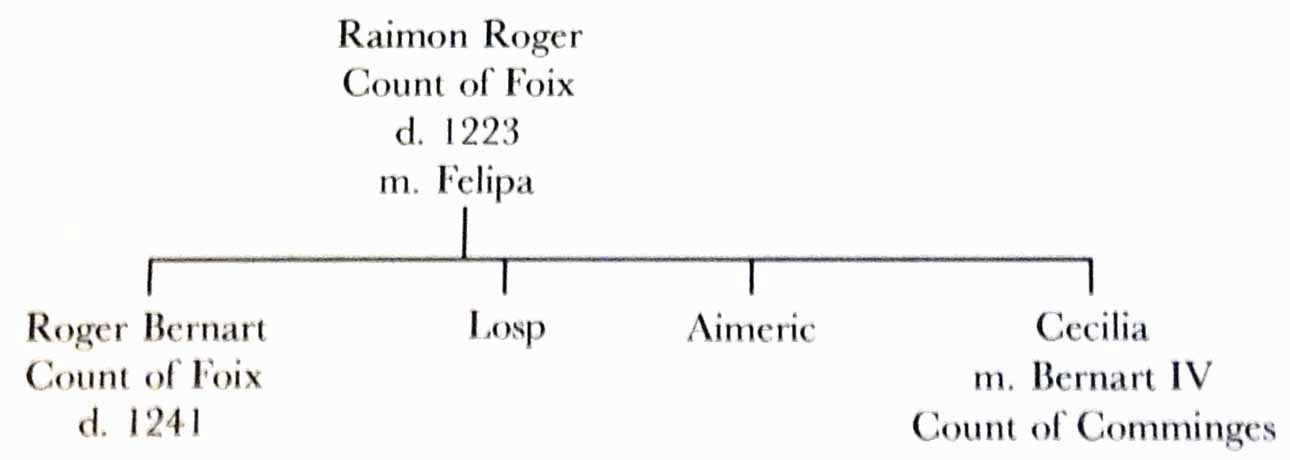
Family trees of the Counts of Foix can, of course, be found in some modern books on the subject.  I was able to find only two, from Elaine Graham-Leigh's The Southern French Nobility and the Albigensian Crusade and Mark Pegg's A Most Holy War:


from Elaine Graham-Leigh, The Southern French Nobility and the Albigensian Crusade, p. xx

from Mark Pegg, A Most Holy War, p. xxv
 Aside from the authors' preferences for spellings, the family trees are identical.  (Presumably, the rendering of "Loup" or "Wolf" as "Losp" (sic) in A Most Holy War is a typographical error.)  Assuming also that both authors are following the convention of listing siblings from oldest to youngest and writing them from left to right, we would understand that Roger Bernard, the heir of Foix, was the eldest brother, Loup was the middle brother, and Aimery was the youngest brother (and hence the hostage), while the youngest of all the siblings was their sister Cecile.  But as these family trees are not referenced with footnotes, we are still left with the question of how historians know which of Loup and Aimery was the youngest, and of how anyone knows of Aimery at all.

AN INFLUENTIAL EDITION


From where have these three historians drawn their information?  This appears to be revealed by the Siblys' misattribution of the information to William of Tudela's Canso, which they erroneously claim identifies Aimery as the hostage.  The version of the Canso which the Siblys cite is the French La Chanson de la Croisade Albigeoise, edited and translated by Eugène Martin-Chabot, who provides the definitive modern rendering of the Occitan text alongside his French translation and copious notes.  This is the edition used by most scholars.  I quote the Shirley edition in this blog because it has the benefit of being in English.  In their introductions, both the Siblys (translators of the Historia Albigensis) and Shirley (translator of the Canso) acknowledge their debts to Martin-Chabot, both for his edition of the Occitan and for his insightful interpretations.

Looking at William of Tudela's passage describing the hostage on p. 101 of Martin-Chabot's definitive French edition, we see the following footnote (3):

Raimond-Roger, qui vécut jusqu'au mois de mars 1223; les conditions de cette paix sont résumeés dans Pierre des Vaux-de-Cernay (chap. xxv, § 120), qui n'as pas spécifié lequel de ses fils le comte remit en otage; d'après Guillaume de Tudèle, ce fut le cadet, nommé Aimeri (cf. Histoire de Languedoc, t. VII, p. 68)

My rough translation of this footnote into English is:

Raymond-Roger, who lived until the month of March 1223; the conditions of this peace were summed up in Pierre des Vaux-de-Cernay (chap. xxv, § 120), who did not specify which of his sons the count gave as a hostage; following William of Tudela, this was the youngest, named Aimeri (cf. Histoire de Languedoc, t. VII, p. 68)

Of course, with a fourth historian we have found a fourth version of the young man's name.  We may also note that the format of this footnote -- reporting that Raymond-Roger died in March 1223 and then adding that his youngest son's name was Aimeri -- is duplicated in shorter form by Janet Shirley in her footnote to the same passage, so presumably she is also following Martin-Chabot in this identification.  Fortunately, Martin-Chabot provided a source for his conclusion that the son was named Aimeri. 

DOM VAISETTE'S 18th CENTURY COLLECTION


The Histoire de Languedoc (or L'Histoire générale de Languedoc) is an 18th century compendium of documents by the Benedictine monk Dom Joseph Vaisette.  Its third volume, which includes those documents most relevant to the Albigensian crusade, was published in 1736.  The series was re-edited in the 19th century and expanded to include additional sources.  It is not copyrighted and can be found on Google Books and other places online.  For volume VII, see: https://archive.org/details/histoiregnra07viccuoft.  The page cited by Martin-Chabot contains a discussion of the sons of the count of Foix, in which we find:


My rough translation into English:

Raymond-Roger did not make mention in his testament of the month of May 1222 but of two of his sons and of one daughter, to wit: of Roger-Bernard II, his oldest son, whom he made his heir, and who had, by then, been married for a long time to Ermessinde, heiress of Castelbon; of Aimeri, his second son, and of Cecile who married Bernard VI,

This presents a serious problem.  If the Histoire de Languedoc is our authority for the family of Raymond-Roger of Foix, which it appears to be, then Aimery was the second of the count's sons and not the youngest.  Raymond-Roger's testament mentions only his two eldest sons and one daughter, but we know of others and, if the Histoire is correct, they were younger than Aimery.

The Histoire de Languedoc does not mention the hostageship of the son of the count of Foix and therefore makes no inferences as to the identity of the hostage. The document does, however, present its own reference for Raymond-Roger's last will and testament in footnote (4) of the above.  It is Pierre de Marca's Histoire de Béarn, 1. 3, c. 20, n. 7.  

PIERRE DE MARCA'S 17th CENTURY COLLECTION


Pierre de Marca was a French bishop and historian who, in 1640, published his Histoire de Béarn, the earliest modern collection of historical documents relating to the area.  Unlike the meticulous work of Dom Joseph Vaisette, a hundred years later, Pierre de Marca's work was rather sloppy.  He frequently gave his own rough translations or summaries of documents he had found, rather than including the original texts, and his inferences were often incorrect.  Dom Vaisette was frequently at pains to point out errors made by his 17th century counterpart.

The Histoire de Béarn is also free of copyright and freely available online.  I found it at: books.google.co.uk/books?id=U6yAfsieJe8C. 

In Chapter XX, Section VII of the Histoire de Béarn, Pierre de Marca paraphrases the last will and testament of Raymond-Roger of Foix, written in 1222.  As Dom Vaisette had noted, he mentions two sons and a daughter.  No other children are mentioned in this document, although the document is not reproduced in the text, but merely described.


My rough English translation:


Raymond Roger made his testament, the day before the Ides of May of this year 1222.  He established as heir to all the county of Foix and its appurtenances, his son Roger Bernard.  Left to his son Aimeri, by means of this establishment, all his property in the dioceses of Narbonne, and of Carcassonne.


It appears to be on the basis of this testament, written 13 years after the hostage transaction of 1209, that Pierre de Marca concluded that the hostage must have been Aimeri.  Pierre de Marca presented this conclusion earlier, in Chapter XV, Section V:


My rough English translation: 

This son whom the count Raymond-Roger gave as a hostage, was the youngest of his children, according to the Chronicle manuscript of count Raymond: this son was named Amauri, in the testament of his father.

This shows two things.  First, that Pierre de Marca based his conclusion on the testament previously mentioned, and second that he did not devote any considerable rigor to this identification, incorrectly recalling the son's name as "Amauri" rather than as "Aimeri".  These two were not different spellings of the same name, but rather different names altogether, although their similarity explains Pierre de Marca's error.

Interestingly, Pierre de Marca's book also includes another document, this one dating from 1229, when Roger-Bernard, now having succeeded his father as count of Foix, made his submission to the French crown and the Church.  In Chapter XXI, Section X, Pierre de Marca translates Roger-Bernard's document, in which he mentions his brothers "Aimeri, & Loup, & Athon Arnaud":


 If nothing else, this highlights how little we know of count Raymond-Roger's sons.  Those who did not inherit significantly from him were scarcely mentioned in the texts.  Roger-Bernard is well-attested, Loup's battlefield prowess earned him mention by the Anonymous Continuator, and Aimery's inheritance got him included by Pierre de Marca in his summary of the count's last will and testament.  But another son, Athon Arnaud, is found here only by chance.

It seems reasonable to conclude, as Dom Vaisette did in his Histoire de Languedoc that Aimery was a second son.  Although not the heir to the county of Foix, as a second son he still merited substantial inheritance.  Certainly there is nothing to indicate that Aimery was a "youngest son" who inherited despite the claims of older brothers.

If Aimery of Foix was his father's second son and not the youngest, however, he could not be the hostage referred to by William of Tudela.  Pierre de Marca, in 1640, based on a careless reading of the documents he had gathered, recalled a younger son being mentioned in a testament.  The second son "Aimeri" of the testament became in his mind the youngest son "Amauri" and filled the role of the hostage mentioned in the Canso. 

Many of Pierre de Marca's errors were corrected a century later by Dom Vaisette in his Histoire de Languedoc but he did not share Pierre de Marca's goal of telling the story of the Albigensian crusade and as a result made no comment about the hostage son of the count of Foix.  It was therefore Pierre de Marca's assumption that this was Aimery that passed down to later historians, starting with Eugène Martin-Chabot in his La Chanson de la Croisade Albigeoise and continuing to the present day.  Dom Vaisette stated in a different context that Aimery was likely the second son of Raymond-Roger of Foix, but as that passage related to a different topic, it may have been missed.  And so, over the course of three hundred and fifty years, careless assumption became historical fact.

Friday, 18 October 2013

Hostages of the Albigensian Crusade, part 1

As I read over the primary sources, several small topics arose which puzzled me.  One of these was the role of hostages.  Several examples appear in the Historia Albigensis and the Canso.  To the authors of these works, the taking of hostages seemed quite ordinary.  It did not appear to them to be notable enough to require any special explanation of the practice.  To the modern reader, however, the appearance of these hostages (and the frequent lack of any mention of their fates) presents a significant challenge in understanding the hostage exchanges described, what they meant to the participants, and what effect they may have had on subsequent events.

I had put the issue of hostages aside for some time when I came across a copy of Adam Kosto's "Hostages in the Middle Ages".  Kosto provides a comprehensive and intriguing analysis of the institution of hostageship throughout the medieval period and even, as it turned out, mentioned some instances of hostages in the Albigensian crusade about which I had not previously read. What follows is a brief discussion of the references to hostages which I have found, and some speculation as to the circumstances to which these references might refer.

Some Generalisations on Hostageship


Nowadays, when we think of hostages, we think of civilians suddenly abducted or held at gunpoint, subject to the threat of immediate death unless the demands of their captors are met.  In these instances, hostage-takers are almost always groups smaller and weaker than the adversaries of whom they make demands.  In the middle ages, however, hostages served a fairly different role.

Hostages, as Kosto puts it, served as guarantees of an agreement, and exchanges of hostages were a normal part of political, military and even financial agreements.  In a time when no higher authority could be expected to enforce agreements between parties, hostages were used as sureties.  When nobles parlayed, the weaker noble would often give a son into the keeping of the stronger, theoretically ensuring that he would stay true to the pledges he gave.  Hostages might be given to ensure that a truce was respected, that promised properties were handed over, or that debts were repaid.  Further, hostages were frequently offered as a show of good faith, rather than demanded under threat of force.  The institution of hostageship was so common that medieval chroniclers often did not note it in great detail, omitting to mention if or when hostages were eventually released.

The conditions under which hostages were kept varied immensely, but the danger of execution by the recipient of the hostage was not as great as might be expected.  Although the idea remained that the hostage guaranteed the agreement, it was quite rare that hostages would be killed when the agreement was violated.  Dead hostages were of no use in further negotiations and in the particular case of sons used as hostages, could form the basis of a feud which would continue long after the violation of the agreement had been resolved.  Furthermore, hostages treated well in the captor's entourage were often eventually useful as negotiators with the other side.  Hostages were indeed killed, from time to time, sometimes for violations of the agreement and sometimes for other reasons, but these appear to have been unusual occurrences.

The first example of hostageship in the Albigensian Crusade which I will examine here does not appear to have been unusual for its time, but it highlights the difficulties historians have in approaching the strange practice of hostage exchange.

Raymond-Roger of Foix's son


William of Tudela wrote in the Canso (Laisse 41, pp. 29-30) about the situation immediately after the fall of Carcassonne in August, 1209:
 When the crusaders had gone back to their own lands, the count de Montfort was left in great difficulty and almost without companions after their departure.  He now reached a settlement with the count of Foix, who voluntarily gave him his youngest son as a hostage.  This agreement did not last long, for they soon broke all its terms and then made vigorous war on each other.

This is the first mention of Raymond-Roger, the count of Foix, in the Canso although the crucial role he was to play later as a military opponent of the crusade indicates what an important agreement this must have been for Simon de Montfort.  Some clues as to what the agreement may have been are provided by Peter des Vaux-de-Cernay in his Historia Albigensis (V, § 120, p.66):

Returning from Limoux, the Count went to a fortress named Preixan, which was near Carcassonne and belonged to the Count of Foix, and laid siege to it.  Whilst the siege was still going on the Count of Foix came to the Count and swore to stand by the orders of the Church in all things and gave his son to the Count as a hostage; in addition he handed over the castrum under siege.  After this, the Count returned to Carcassonne.

Peter records the subsequent failure of this agreement in (V, § 134, p.73), after recounting the rebellion of Castres and Lombers against de Montfort:

At this time the Count of Foix who had as previously narrated made a pact of friendship with our Count, in an act of treachery took over the castrum of Preixan which he had previously handed over to him.  He abandoned his alliance with our Count and began to attack him vigorously.  A little later, on the feast of St Michael, this traitor came by night to the castrum called Fanjeaux and arranged for ladders to be erected against the walls.


The negotation which had occurred between de Montfort and the count of Foix was referred to as a "settlement" and "agreement" by William of Tudela and as a "pact of friendship" and "alliance" by Peter des Vaux-de-Cernay.  Both authors mention the giving of the count's son as a hostage.  William notes that this was done "voluntarily" by his father.  As noted above, a hostage might be offered or given, not under threat, but as a show of good faith.  Certainly, it does not appear that by this point the Count of Foix was in dire straits in his conflict with the crusade.

The Identity of the Hostage


The identity of this hostage, the "youngest son" of the count of Foix, has generally been thought to be Aimery. This is the conclusion of Janet Shirley, translator of the Canso.  Laisse 41 of the Canso, quoted above, states that "the youngest son" of the count of Foix was the hostage and Shirley, in a footnote to this laisse notes that "his youngest son's name was Aimery".

The make-up of Raymond-Roger's family is not detailed by our chroniclers, but the identification of the hostage with Raymond-Roger's son Aimery seems to have been made in 1640 by the bishop and historian Pierre de Marca in his book "Histoire de Béarn", in which he recounted the history of the Albigensian crusade and of the counts of Foix.  Pierre de Marca included in his book several charters and other documents which he had found relating to his subject, many of them either paraphrased by him or translated by him into French.

 In Chapter XX, Section VII of the Histoire de Béarn, Pierre de Marca paraphrases the last will and testament of Raymond-Roger of Foix, written in 1222.  In it, he leaves the county of Foix to his son Roger-Bernard, and his holdings in the dioceses of Narbonne and Carcassonne to his son Aimeri.  Some arrangements are also made for his daughter Cécile.  No other children are mentioned in this document, although the document is not reproduced in the Histoire, but merely described.

It appears to be on the basis of this testament, written 13 years after the hostage transaction of 1209, that Pierre de Marca concluded that the hostage must have been Aimeri.  Pierre de Marca presented this conclusion earlier, in Chapter XV, Section V:


(my rough translation:  "This son whom the count Raymond-Roger gave as a hostage, was the youngest of his children, according to the Chronicle manuscript of count Raymond: this son was named Amauri, in the testament of his father")

This shows two things.  First, that Pierre de Marca based his conclusion on the testament previously mentioned, and second that he did not devote any considerable rigor to this identification, incorrectly recalling the son's name as "Amauri" rather than as "Aimeri".  The two were not different spellings of the same name, but rather different names altogether, although their similarity explains Pierre de Marca's error.

Now, Raymond-Roger of Foix had other children than the three mentioned in his testament.  Loup, or "Wolf" appears in the Canso, but is thought by Shirley, the translator, to be illegitimate because he does not also appear in the paraphrase of his father's testament.

Interestingly, Pierre de Marca's book also includes another document, this one dating from 1229, when Roger-Bernard, now having succeeded his father as count of Foix, made his submission to the French crown and the Church.  In Chapter XXI, Section X, Pierre de Marca translates Roger-Bernard's document, in which he mentions his brothers:


Here, three brothers are mentioned: Aimeri, Loup and Athon Arnaud.  Even in genealogies of the counts of Foix which mention Loup, such as in Elaine Graham-Leigh's "The Southern French Nobility and the Albigensian Crusade", Athon Arnaud does not appear.  This exclusion may be because he does not appear in other texts.  However, his appearance here highlights how little we know about the children of Raymond-Roger of Foix.

It may be that Loup and Athon Arnaud do not appear in the testament because they were illegitimate sons.  It may also be that they did not inherit in that testament in order that the holdings of the house of Foix were not split up and distributed too widely.  Regardless, it appears to be an unwarranted assumption that the only other son mentioned in the testament of 1222 must have been the "youngest son" given in 1209.

Neither William of Tudela nor Peter des Vaux-de-Cernay mentions what happened to the hostage as a result of the continuation of hostilities.  He does not appear again in either text.  If it was, in fact, Aimeri then he would appear to have survived his ordeal.  But that is by no means proven.  If Raymond-Roger had another son whom he gave as a hostage and that son did not survive to 1222, or did not inherit in Raymond-Roger's testament, we would not know from the sources we have.

The above is based on the assumption that we have no better sources on the count of Foix's family than what Pierre de Marca was working on.  So far, I have not found any, although I have made inquiries and stand to be corrected should any turn up.  If so, I will certainly add to this post.

The Duration of the Peace

Although the giving and taking of hostages was a frequent occurrence to guarantee agreements, it often appears to have been unsuccessful, as it was in this case.  Whatever the details of the agreement between Raymond-Roger of Foix and Simon de Montfort, the deal was broken very quickly and they found themselves at war soon after the count of Foix's young son was handed over to de Montfort.  Typically, Peter des Vaux-de-Cernay places all blame for the breakdown of the agreement on the treachery of the Count of Foix, but it is interesting to note that William of Tudela noted that "they" (i.e. both Simon de Montfort and Raymond-Roger of Foix) broke the agreement and attacked each other.  


Peter gives us no indication of the date of this agreement, so some educated guesswork must be employed.  The only firm date which we have around this time is for the crusade's arrival at Carcassonne, which is mentioned in the legates' letter to the Pope as being on the feast day of St Peter in Chains, August 1st.  The translators of our primary sources suggest that Carcassonne surrendered on August 15th, but this appears to be an estimation based on the length of the siege and of negotiations.  Peter des Vaux-de-Cernay reported that Simon de Montfort was then elected leader of the crusade, stayed a few days at Carcassonne,  then went to Fanjeaux, then Castres, then returned to the neighbourhood of Carcassonne, then back to Fanjeaux, then to Mirepoix, then to Pamiers, then back to Fanjeaux again, then on to Lombers, then to Albi, then Limoux, before beginning the siege of Preixan.  Our estimate of the date of the agreement is important as it will give us some indication of how long it lasted, but clearly a great deal of time must have passed since mid-August.

The agreement failed when the count of Foix retook Preixan and Peter des Vaux-de-Cernay reported that "a little later", he attacked Fanjeaux on the Feast of St Michael.  That falls on September 29 and is the only other firm date presented for this period.  It is likely that Peter des Vaux-de-Cernay has made an error here.  After his agreement with the Count of Foix, Peter related that Simon met King Pedro II of Aragon in Montpellier and "stayed for fifteen days".  Following that unsuccessful diplomatic effort, Simon attempted to relieve some of his knights who were besieged, but could not cross the flooded river Aude and returned to Carcassonne, where another hostage, the young Viscount Raymond-Roger Trencavel, had just died in prison.  He then heard that Giraud de Pepieux had turned against him and rode out to Puisserguier to face him.  He then razed "numerous castra and after a few days returned to Carcassonne".

Although many dates here are not given, clearly far too much has happened in order to be fit between the siege of Carcassonne on August 1st and the Count of Foix's attack on Fanjeaux on September 29th.  A clue as to how to correct Peter des Vaux-de-Cernay's mistakes is the death of the young Viscount, which the necrology of Carcassonne gives as November 10th.  The Siblys, in their translation of the Historia note this discrepancy and devote their Appendix E to an attempt to resolve it.  Their conclusion seems to be, quite reasonably, that Peter des Vaux-de-Cernay was incorrect about the Feast of St Michael and that the Count of Foix retook Preixan and Fanjeaux sometime in November or December of 1209.  They note that some historians, including Roquebert, disagree and accept Peter's date for Fanjeaux, attempting to re-order Simon's other activities in order to fit a reasonable timeline.

Whichever of these hypotheses we are to accept, we are left with an agreement which lasted a very short time -- either a matter of days or two to three months.  It is possible that Raymond-Roger's son was given as a hostage only very temporarily, perhaps to ensure the smooth handing over of Preixan, and returned to his father immediately after.  This does not fit well, however, with Peter des Vaux-de-Cernay's description.  Peter is the only one who suggests some of the terms of the agreement -- that the count of Foix would stand by the orders of the church in all things -- and states that Raymond-Roger gave his son as hostage to guarantee this agreement.  He then states that "in addition" the castle of Preixan was to be handed over.  This would seem to imply that the agreement was indefinite and the quick return of the hostage was not anticipated.  In that case, Raymond-Roger of Foix would have retaken Preixan knowing that Simon de Montfort continued to hold his son at his mercy and was either willing to sacrifice his son to his other goals or was confident that de Montfort would not kill him.  If that was the gamble he took, it may not have been a desperate one.  Simon de Montfort would have gained little from being known as a cold-blooded executioner of a noble youth given to him voluntarily and may have been successful at using the hostage in some future negotiations over the following 9 years.  History does not relate.

Conclusion


As is typical of medieval accounts of hostageship, this one raises more questions than it answers.  Aside from the doubt about the identity of the hostage, it is strange indeed that the peace agreement broke down as quickly as it did.  Presumably, this did not lead to the execution of the hostage as that would likely have been notable enough to be recorded by one of our sources.  Why the hostage was given, and whether it had any effect on relations between Simon de Montfort and Raymond-Roger of Foix remains open to speculation.  Clearly, any consideration of risk to the hostage did not long delay the commencement of hostilities. 

In my next post, I will examine a quite different hostage-taking: the rounding up of the citizens of Toulouse.

Friday, 4 October 2013

The things you can find out about the Cathars!

I've had the flu lately so I haven't posted my next article as soon as I'd hoped.  It'll be about the intriguing role played by hostages in the Albigensian Crusade, with insights gleaned from the book I'm currently reading, Kosto's "Hostages in the Middle Ages".

In the meantime, my partner found this quite amazing grocery display sign at a small market in Nottingham:


I haven't yet tracked down the heretical cookbook which provided this crucial bit of historical knowledge, but we have been enjoying the garlic.

Tuesday, 17 September 2013

The miraculous in the Anonymous Continuator

The second part of the Canso, written by the Anonymous, continues in mid-sentence from the first, but deserves to be viewed separately.  Its unnamed author shares in William of Tudela's work, but not in his perspective on events, and also not quite in his descriptions of divine intervention in the events of the Albigensian crusade.  Like William, the Anonymous refers to miracles and the demonstrations of God's will only in relation to natural events which are completely credible without requiring a supernatural explanation.  In this way, he differs from Peter des Vaux-de-Cernay.  However, like Peter des Vaux-de-Cernay (and unlike William) the Anonymous, in some places sees the course of the war as dictated by divine favour for one side exclusively.

THE FIRST MIRACLE


The Anonymous begins his writing in Laisse 132 of the Canso after William of Tudela's abrupt disappearance as author.  A miracle is recorded by the Anonymous for the first time not long afterward in Laisse 142 (p. 72).  It is after the battle of Muret and Count Raymond VI of Toulouse, defeated along with his allies by Simon de Montfort, leaves Toulouse to surrender and goes to Rome to appeal to the Pope:

"Now let us return to the valiant count who went away a landless man.  Harsh have been his trials both by land and sea, yet God and the Holy Spirit brought him safe by miracle to harbour.  With but few companions, he and his young son arrived in Rome, where they met with much joy and told each other that God should be their guide."

Certainly the crushing defeat at Muret would be a harsh trial by land, but it is unclear what harsh trial by sea might be referred to here.  The journey is not recorded in the other sources.  Perhaps the voyage by ship to Rome was beset by storms.  The miracle which the Anonymous points to here does not seem to have been the count's survival at Muret as it is his safe arrival "at harbour" specifically which seems to have been miraculous. 

What is clearer is that count Raymond's setbacks up to this point are constructed by the Anonymous into a narrative of trial, like those of biblical figures who endure tragedy and disaster so that they may ultimately prove their righteousness and be rewarded.  It is the beginning of the framing of events in a manner similar to and opposite of that of Peter des Vaux-de-Cernay. 

THE SECOND MIRACLE


The next sections of the Canso concern the many deliberations at the Papal Court and the Fourth Lateran Council.  The Anonymous then goes on to discuss the successful rebellion by the Raymonds of Toulouse in which Beaucaire is besieged and Simon de Montfort's efforts to relieve the siege fail and end with the surrender of the garrison and de Montfort's furious withdrawal to Toulouse.  These events are described without any attribution of divine intervention by the Anonymous, although he frequently has characters on both sides expressing their opinions about God's will and favour. 

In Laisse 180 (p. 119) the Anonymous has just been describing Count Simon's successes at subduing the surrounding countryside and is about to relate Count Raymond entering Toulouse with the assistance of divine intervention.  He foreshadows the upcoming miracle by reminding his audience unequivocally about God's intentions:

"These were serious setbacks for the Provencals, but then God caused a kindly light to shine upon them from Toulouse, one that blazed across the world, restored vigour to paratge and splendour to worth, for their lord the count, so much endangered, so wrongly disinherited by the mighty pope and the other clergy, arrived in a fief where he found loyalty, that of Sir Roger of Comminges."

With Roger's help, count Raymond rides for Toulouse, having a minor battle with crusading forces along the way.  Simon de Montfort is not yet at Toulouse but the city is held by the French (that is, by the crusaders) and Raymond must enter it without attracting notice.  In Laissde 181 (p. 122):

"All that day they rode along smooth highways until darkness fell.  Then the count chose good faithful messengers and briefly told them to tell his sworn friends in the town that he and the other dispossessed men had arrived outside; let them come without fail to welcome him.  At sunrise when the day began to brighten and they saw the dawn, the count was anxious in case he should be seen and the news of his arrival be spread all over the country.  But God worked a miracle for him -- the weather darkened and a grey mist filled the air, so that the count got safely into woodland and was soon hidden."

Count Raymond immediately subsequent to this retakes Toulouse and almost the entire rest of the Canso will be devoted to the resultant military conflict as Simon de Montfort and his crusaders attempt lay siege.  This miracle, then, demonstrates how God from the beginning facilitated Raymond's righteous claim to Toulouse, after he had suffered his trials.

THE THIRD MIRACLE


As word spread throughout the Languedoc that Toulouse had been retaken by count Raymond, crusading forces began to respond.  The defensive situation would be difficult as Simon de Montfort had previously torn down walls, towers and defenses and sent his sergeants to disarm the population.  The first to reach Toulouse was Guy de Montfort, Simon's brother.  He led an immediate assault on Toulouse's defences which was fiercely repulsed by its defenders, in the first of a series of surprising outcomes when small numbers of poorly armed defenders fought well equipped attackers.  In Laisse 185 (p. 126):

"On one and the other side the strife is sharper, for pride and vainglory have been flung out of Toulouse and Count Raymond directs and sustains the town.  Many long years have he and his kin been here, and clearly it is God who has given the place back to him.  Unprovided, weaponless, with only a few men and a handful of foreign troops, but with steadfast hearts, Count Raymond with God's help has driven out the Normans and the French.  The Lord God is merciful to sinners who show mercy, he has given the town back to Raymond whose flag now flies there -- may he look well on right and reason, on wrong and treachery, may he hear the cries of his faithful flock, defend Toulouse and guide those who love him!"

While no individual miraculous event is described, the Anonymous is clear that it is God who assigned victory to Raymond's side and who provided the help needed to achieve it.  This is reinforced in Laisse 186 (p. 130) as Simon de Montfort gathers all of his troops and rides hard for Toulouse himself.  He is counseled by Cardinal Bertrand, the papal legate, and Bishop Fulk of Toulouse with advice which recalls the massacre at Beziers:

"'Count,' said the cardinal, 'how glad you must be that the day of your enemies' defeat has come!  You will of course take the town.  As soon as you enter it, have the men hanged and the counts put to death.  Take care that no one escapes.'
'My lord,' said the bishop, 'the Church must save all who are in a church within sight of the altar.'
'No,' said the cardinal.  'This was decided when sentence was passed.  I abandon them to you, Count.  Never fear that God will require them of you or exact repayment!'  But the cardinal was wrong, for the king who rules, who sees straight and clear, who gave his precious blood as a remedy for sin, he wills to defend Toulouse."

THE FOURTH MIRACLE


Simon's attacks on Toulouse were indeed all forced back by the defenders and the siege of Toulouse turned into a protracted and expensive affair, full of frustration for the crusaders.  The arrival of the Count of Soissons to join the besiegers gave a much-needed boost to their spirits, although the Anonymous depicts the Count of Soissons as a constant and blunt critic of de Montfort and his policies.  Nonetheless, the troops he brought with him for their forty-day service proved a grave threat to Toulouse, alleviated only by the sudden arrival of count Raymond's son, the young Raymond VII of Tououse.  In Laisse 201 (p. 162):

"There was great anxiety inside Toulouse, for so many enemies now hemmed them in and all Christendom was gathering to destroy them.
But now to comfort them the Virgin's Son sent them joy, sent them an olive branch, a bright star, a glory on the mountains, for the brave young count, daylight, inheritor, rode in through the gateway with cross and steel.  And God sent him a marvel, a true sign that he would bind the murderous lion in chains, for from the highest battlement of the bridge tower first captured by the French, the banner fell, the lion tumbled down into water and sand, and this delighted everyone in the city."

Throughout the Canso, the Anonymous ignored the crusading rhetoric which informed Peter des Vaux-de-Cernay and depicted God as uniformly on the side of the crusade.  When the Anonymous depicted God uniformly supporting the southerners, he was just as forceful in his rhetoric and did not see the need to present any argument against the idea that God supported the Church and the crusade on theological grounds.  Instead, he railed against the unjust nature of their cause and the cruelty of their methods and asserted the traditional rights of the defenders as sufficient to merit God's favour.


THE FIFTH MIRACLE


After more fiercely contested fighting over the river towers, and a damaging sortie by the Toulousains, Simon de Montfort decided on a fresh assault on the city.  To effect this, he used a "cat" -- a mobile defensive structure covered with hides and shields which could be dragged up to the walls and provided those inside with cover against missiles from the defenders as they approached.  The initial assault had to be aborted when two well-placed shots from a trebuchet within Toulouse, "straight as a hawk swoops on a small bird" cause serious damage to the cat and kill many inside.  The cat had to be turned around and dragged back out of the range of the defenders for repairs.  As those repairs were made, it became clear to the defenders that another protected assault would follow and they resolved to improve their defensive walls, even though that work would expose them to fire from the besiegers.  In Laisse 203-204 (p. 167):

"They began the outworks, the doors and hatches.  Knights and citizens handled the stones, as did noble ladies and their daughters, young men, little girls and boys, everyone, great and small, and they sang songs and ballads as they worked.  Thick and fast the besiegers' mangonels shot at them, archers and slingers loosed bolts and stones, knocked the bowls and pitchers off their heads, smashed handles and head-pads and pierced their legs, their hands and fingers.  But so firm and strong was their courage, not one of them took fright.

Not one of them took fright, far from it.  They were delighted to be building shelters to protect the ditches, and the whole community worked with great joy.  But the besiegers' mangonels and bent bows poured stones and feathered bolts into the thick of them and from the side too, piercing legs, chests and arms and shattering beams, posts and timbers.  But the Virgin's Son kept them safe and there was almost no damage done in the town."

After the graphic depiction of injuries to legs, hands, fingers, chest and arms, it comes as a surprise to hear that the Toulousains were kept safe during this work.  Perhaps the Anonymous is referring more to the lack of structural damage to the defenses which they were building.  Still, it is clear from the repeated descriptions of injuries that the divine intervention mentioned here was not immunity to injury from the besiegers' missiles and, in fact, shared credit with the courage of the people of Toulouse who persevered in the work despite the very real risk of being hurt or killed.

The defenders of Toulouse then decided to sortie to burn the cat and it was during the ensuing battle that Simon de Montfort was killed.  This broke the morale of the crusading army, which lifted the siege. 

THE SIXTH MIRACLE


Amary de Montfort took over his father's position but could not continue the attack on Toulouse and soon found himself on the defensive against the young Raymond of Toulouse.  With the assistance of the count of Foix and others, young Raymond attacked a crusading army at Baziege.  The Anonymous gave a long and graphic depiction of the young count's victory, ending in Laisse 211 (p. 186):

"Steel flashed on steel, on overthrown and beaten men; knights and sergeants struggled, and they slashed, slew and finished them.  Eyes, brain-matter, hands, arms, scalps and jaw-bones, bits of limbs, livers and guts sliced up and tossed about, blood, flesh and carrion lay everywhere.  Red was the battlefield and red the riverbank, heaped with dead Frenchmen.  The viscount of Lautrec, however, escaped with his life.  Sir Foucaud, Sir John and Sir Theobald surrendered and were kept, but the rest lay slaughtered on the battlefield.
It was a miracle of the holy Trinity that none of the count's men were hurt in this affair, except one squire who rode too far ahead.  The battle won and the field stripped, the count rode back in great joy."

Accounts which emphasize the one-sidedness of a battle's results are not uncommon and a bit of exaggeration in this regard might be expected.  However, it is striking that the Anonymous uses the lack of injury on the victorious side as a miraculous indication of divine favour in just the same way that Arnald Amalric and the other prelates did in their account of the battle of Muret, where they described God's victory costing their enemies tens of thousands of lives while their own forces had lost "only one of Christ's knights ... and a few sergeants".

There are no further miracles in the text.  Prince Louis marched from France with a huge army and massacred the population of Marmande before marching on Toulouse.  The Canso ends as the city prepares to defend itself.  The final laisse is 214 (p. 191-194), which finishes by invoking divine protection in the upcoming conflict:

"Now may the Virgin's Son, full of light and glory, who gave his precious blood for mercy's victory, defend reason and law, may he cause the guilt of wrongdoing to fall on those who purpose sin!  For now the son of the king of France comes in pride bringing thirty or forty counts and so many troops that no man alive can reckon up their thousands and hundreds.  The cardinal from Rome too, he comes proclaiming that death and slaughter must lead the way, that in and around Toulouse there shall remain no living man, neither noble lady, girl nor pregnant woman, no created thing, no child at the breast, but all must die in fire and flames.
But the Virgin Mary will save them from this, she who puts right all that is wrong, so that innocent blood will not be shed.  They will not be afraid, for St Sernin leads them, and God, justice, strength, the young count and the saints will defend Toulouse for them.
Amen."

We cannot know if the Anonymous really wrote this ending at the time it described, or if he had the benefit of hindsight in knowing that this second siege of Toulouse, although much larger than the first, would also end with the crusading forces raising the siege and leaving without success.  It is certainly tempting to conclude that if the Anonymous had known of Toulouse's staunch defense and eventual victory that he would have written about it.  Certainly, the level of detail which the Anonymous includes about the preparations -- right down to who commanded which section of the city -- suggests that he did not have knowledge of what was to come and that he finished his writing before the second siege of Toulouse began.

As with Peter des Vaux-de-Cernay and William of Tudela, it is now impossible to know why the Anonymous ended his story where he did or what sort of editing process occurred after the composition of the last text that we still have.  Of the three authors, though, the Anonymous does seem to have the most finished ending.  Peter des Vaux-de-Cernay trails off after Simon de Montfort's death with some disjointed sections.  William of Tudela stops abruptly, mid-sentence.  The prayer for Toulouse's defense at least provides a narrative closure to the Canso.  In this way, the Anonymous completes also his framework for presenting God's will.  First, God sends trials and tribulations to test the count of Toulouse, then vouchsafes his rights by showing divine favour and granting miracles, and finally God is asked to confirm his judgment by protecting Toulouse in this ultimate conflict.

Although both the Anonymous and Peter des Vaux-de-Cernay reported miracles and wanted to impress upon their audience the extent to which divine favour was clearly on their respective sides, there are crucial differences between their texts.  The Anonymous, like William of Tudela, uses the term "miracle" to describe mundane events which are fortuitous but never inexplicable.  A sea voyage is survived, weather darkens, a banner falls, a victory is achieved with few casualties.  By contrast, Peter des Vaux-de-Cernay asks his audience to believe in columns of fire in the sky, flashing crosses floating in the streets, months-old corpses which don't decompose and smell wonderful, and fire-proof, jumping papers.  He asserts that these impossible things happened, cites apparently reliable sources to confirm them, and holds up their wonder as proof of his theme of divine favour for the crusade.  Neither author of the Canso has any need to cite sources or to defend the credibility of their accounts, since neither recounts "miracles" which amount to more than what we might consider happenstance.  So although the Anonymous sometimes shares Peter's rhetorical requirement of proving that God is on the side he favours, this does not cause the Anonymous to relate events which we know to be false in the process.

Any proper consideration of the relative reliability of these sources must then take into consideration the obvious fact that Peter des Vaux-de-Cernay, intentionally or not, included many events which we now know to be false or wildly inaccurate.  By contrasting his account with that of William of Tudela and the Anonymous we can see that this is not solely due to his religiosity or any unique belief in miracles.  The other contemporary authors were also prone to cite miracles and to see divine intervention in the course of the war.  However, it is only Peter des Vaux-de-Cernay's work which bolsters its narrative framework with clear inventions.  Perhaps this is because of the pressures put on Peter which I previously discussed, or perhaps it is because his intent in writing, as he stated, was only to show God's works while the other authors were making a popular song about current events.  Nonetheless, Peter des Vaux-de-Cernay's extreme unreliability in recounting the miraculous cannot be separated from the rest of his text.  We cannot edit out the impossible and highly improbable and then assert that the remnant is reliable.  Where he differs from other sources, or where only his account relates an important event, it should be remembered that he made his veracity secondary to his narrative purpose in a way which William of Tudela and the Anonymous did not.